Casting number worn off? Six measurements that identify the part anyway
Brake Parts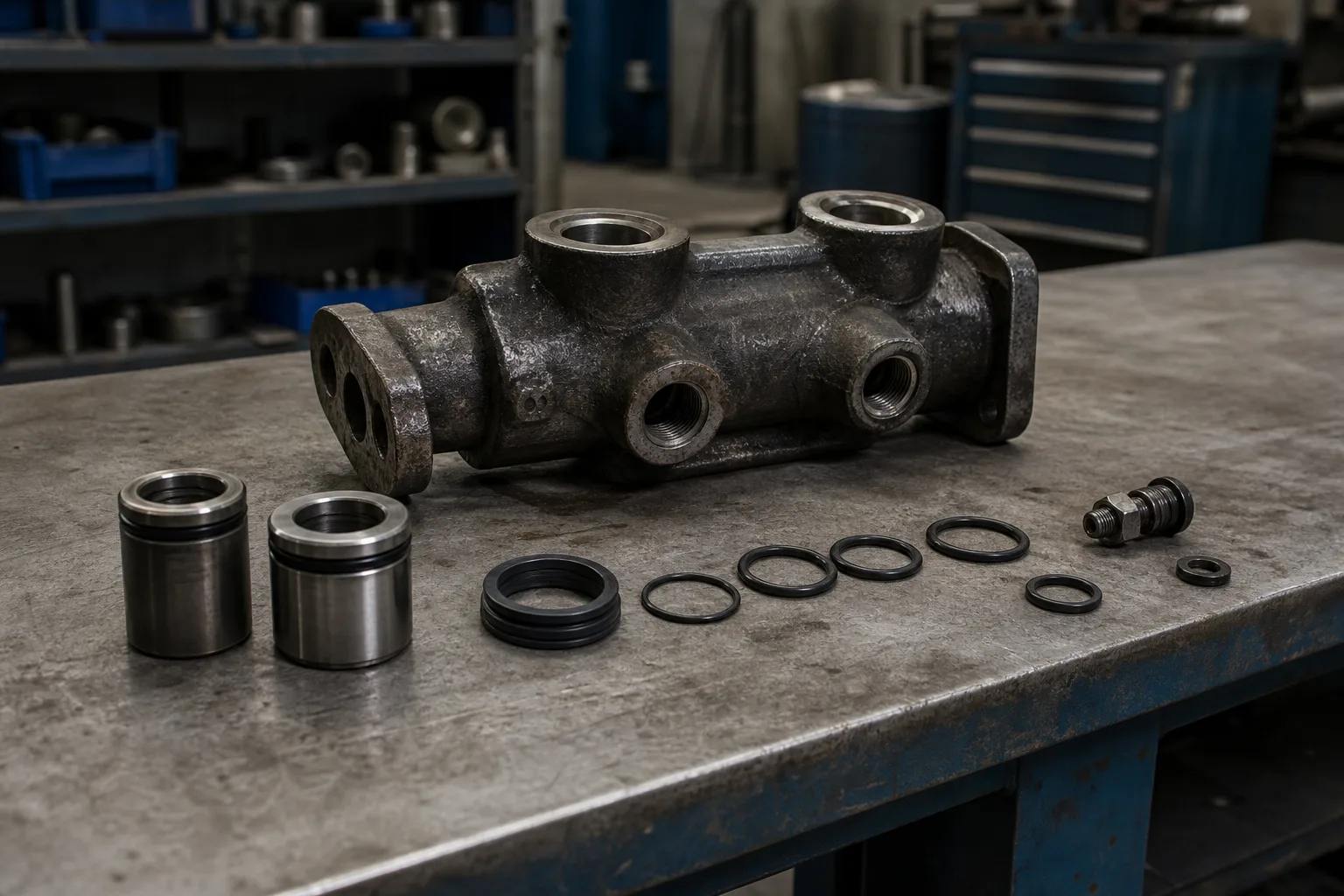
- Two measurements per piston
- Measure a caliper piston at two points ninety degrees apart, since a piston seized in a corroded bore can wear slightly oval. The larger reading is the one to record.
- Tenths, not whole numbers
- Record bore and piston sizes to a tenth of a millimeter. Square-section seals are cut for one nominal size and will not stretch to cover a guess.
- M10x1.0 versus M10x1.25
- Bleeder and inlet threads of the same diameter can carry different pitches that look identical in a parts bin. A five-dollar pitch gauge prevents a cross-threaded aluminum housing.
A caliper that has spent fifteen winters in road salt often has nothing legible left on it. The casting number sits in a recess that fills with rust scale, the paint stamp faded years ago, and wire-brushing the area sometimes takes the raised digits with it. That does not leave you guessing. The part still carries its identity in its dimensions, and those dimensions are what seal kits are actually catalogued against, whatever the vehicle-model dropdown on a parts site implies. Six checks, most of them requiring a caliper gauge and a thread pitch gauge, will get you to the right kit.
1. Piston diameter, measured at the piston, not the bore
The single most useful number is the piston diameter, and it is the one most often guessed at. Measure the piston itself with a dial or digital caliper, at two points ninety degrees apart, because a piston that has been sitting in a corroded bore can wear slightly oval. Common front sliding-caliper sizes cluster around 48, 51, 54 and 57 millimeters, and the gaps between them are wide enough that a careful measurement is unambiguous. Record it to a tenth. A square-section piston seal is cut for one nominal bore only, and a size down will not stretch into place.
2. Bleeder and inlet thread pitch
Thread pitch separates families that otherwise look identical. Run a pitch gauge across the bleeder screw and the fluid inlet, and note both the diameter and the pitch: M10x1.0 and M10x1.25 are visually similar in a parts bin and will cross-thread an aluminum housing in seconds. Inverted flare fittings, banjo bolt threads and bleeder threads are all worth writing down separately, since a caliper can carry a metric inlet and an older-standard bleeder if it was built for two markets. Thread data also narrows the manufacturer, because each caliper maker has habits.
3. Dust boot groove and retaining ring style
Look at how the dust boot is held. Some castings have a machined groove in the bore mouth that accepts a wire retaining ring, others rely on an interference fit between a stiffened boot lip and a counterbore, and a third group clamps the boot under a stamped steel cap. The kit you need reflects that geometry, not the vehicle. Measure the counterbore diameter and its depth, and check whether the boot's inner lip seats in a groove on the piston crown. Those three details usually decide between two kits that share a bore size.
4. Caliper family, read from the body shape
Calipers are designed in families and sold across dozens of vehicles. A single-piston sliding caliper with two guide pins pressed into the bracket, a bridge cast over the disc, and a spring clip retaining the pads is a recognizable design, and the family name is what a rebuilder's catalog is organized by. Count the pistons, note whether the pins thread into the carrier or slide in rubber bushings, and photograph the pad retention. Matching by family sidesteps the model-year problem entirely, because the family is a physical fact about the part in your hands.
5. Master cylinder bore, ports and reservoir mount
Master cylinders identify the same way. Bore diameters of 20.6, 22.2 and 23.8 millimeters are typical, and each one changes pedal travel and pressure, so the number matters mechanically as well as for the kit. Count the outlet ports, note their thread and whether the seats are inverted flare or bubble, and check how the reservoir attaches: grommets pressed into the casting, a bolted flange, or a molded one-piece body. Then measure the pushrod depth and the mounting bolt spacing. The National Highway Traffic Safety Administration oversees the federal standards these hydraulic systems are built to meet.
6. Why one model year holds two answers
The same car often left the factory with two brake setups, and neither is wrong. Trim level, engine option, tow package, wheel diameter, an anti-lock system fitted midyear, or a switch between two suppliers in the same build month will all do it. This is why the build sheet, the VIN-decoded brake option code and the production date on the door jamb sticker are worth pulling before ordering, and why the measurements outranks the catalog when the two disagree. A careful reader treats the vehicle listing as a shortlist and the dimensions as the decision.
Write the six numbers on a card and keep it with the disassembled parts. Sourcing a kit from a rebuilder becomes a short conversation once you can state bore, pitch, boot retention and family, and the same card tells you next time whether the caliper on the bench is the one you already have data for.